

One Week by Car: Visiting Puglia, Italy, and Its Amazing Villages and Food
Of all the regions we visited during our month in Italy, Puglia was my favourite.
Maybe it was the combination of everything we love about travelling – beautiful beaches, fascinating historic towns, incredible food and the freedom to explore by car. Maybe it was that our dollar seemed to go a little further here. Or maybe it was simply that every town felt completely different from the one before it. We also learned that this is one of the regions that Italians visit for their own holidays – so we knew it had to be great.
Whatever the reason, Puglia was the place where I could most easily imagine staying for a couple of weeks rather than just seven days. For our entire Italian itinerary, see this post.
We based ourselves in San Michele Salentino for a week, rented a car and used it as our home base for day trips throughout Puglia. Most drives were between 30 and 60 minutes, and we also ventured a little further into neighbouring Basilicata for a day in Matera.
Here’s what we loved, what we learned and how we’d approach a week in Puglia next time.
Getting around Puglia: Rent the car
For this part of Italy, I highly recommend having a car.
We took the train from Rome to Brindisi and picked up our rental car at Brindisi Airport. Bari is another excellent option if you’re flying into Puglia or arriving by train.
Travelling as a group of seven, we quickly discovered something we wish we’d known before booking: a seven-passenger vehicle in Italy isn’t necessarily what you might expect in Canada.
Our first vehicle was an SUV with two jump seats in the back. That gave us seven seats – but no room for carry-on luggage. For a week of driving between destinations, that wasn’t going to work.
We upgraded to a nine-passenger van. It cost more, but the extra space made a huge difference. We were covering longer distances between towns and needed to drive to Naples with our luggage on our final day, so the additional space was worth every penny. In Tuscany, where we were driving shorter distances, we went back to a smaller vehicle and made it work.
If you’re travelling with a larger family or group, check the actual seating and luggage configuration before you book. Don’t assume that “seven passengers” means seven proper seats plus luggage space.
San Michele Salentino: Our home base
We chose San Michele Salentino as our home base, and I’m really glad we did.
It wasn’t one of the headline destinations that you’ll see on every Puglia itinerary, but that was part of its appeal. We had a chance to experience a smaller local town rather than spending every night somewhere packed with tourists.
We explored the local bakery, visited the butcher and, of course, found our favourite gelato spot. We also bought some local pottery to bring home. A small confession: that pottery then travelled with us for the rest of our month-long trip. Sorry, Robin.
Those everyday experiences were some of my favourite parts of staying in San Michele. We weren’t just visiting Puglia’s famous towns during the day; we were also getting a little taste of what it was like to live there.
We also encountered one of the foods Puglia is famous for – orecchiette. We ate lots of the little ear-shaped pasta that is hand-made by local nonnas. Food wasn’t something we just ordered at restaurants in Puglia; it was part of the everyday life we were seeing around us.
Stay in a trullo
One of the highlights of our Puglia experience was staying in a trullo.
If you’ve never heard of one, a trullo is a traditional stone dwelling with a distinctive conical roof, built using dry-stone construction. They’re one of the defining features of the Puglian landscape, particularly around the Valle d’Itria. Alberobello is home to one of the largest concentrations of trulli, which form part of its UNESCO World Heritage site.
We stayed in a restored trullo booked directly through Trulliese. Their properties are also available through Airbnb, but we chose to book directly. Our hosts, Marina and Laurent, were fantastic. Marina helped us with reservations, recommended places to eat and answered all of our questions. More than that, she helped us experience Puglia as though we were visiting friends rather than simply passing through as tourists. That made a huge difference.
If you’re going to Puglia, I would absolutely consider staying in a trullo at least once.


How we explored Puglia
The choices can feel endless when you start planning Puglia.
You could spend several weeks here and still not see everything.
Rather than trying to build the “perfect” itinerary, we made a list of places that looked interesting, asked our hosts for recommendations and chose a mix of popular destinations and quieter towns.
Because we arrived during a heat wave, we generally explored in the morning, returned to our accommodation for the afternoon and spent time by the pool or resting. Some evenings we’d head back out to explore another town when things cooled down. That rhythm worked well.
Ostuni: My favourite
Of all the towns we visited, Ostuni was my favourite.
Known as the White City, Ostuni sits on a hill and its whitewashed buildings seem to glow in the sun. It reminded me a lot of Greece – the brilliant white buildings, narrow streets and blue sky, all climbing up the hillside.
We visited in the evening, which turned out to be perfect. The temperature had dropped, the town was coming alive for dinner and we wandered through its narrow, winding streets as the sun went down.
Ostuni is hilly and a bit of a maze – but that’s part of its charm.
We had a fantastic aperitivo plate at Borgo Antico Bistrot, which was exactly what we wanted after a day of exploring. We sat, ate, watched the evening unfold and then continued wandering through the streets.
We had planned to return during the day, but never managed to fit it in. In retrospect, I’m glad we experienced it at night. The combination of the white buildings, narrow streets, restaurants and evening light made it one of my favourite memories of Puglia.


Matera: The most unique stop
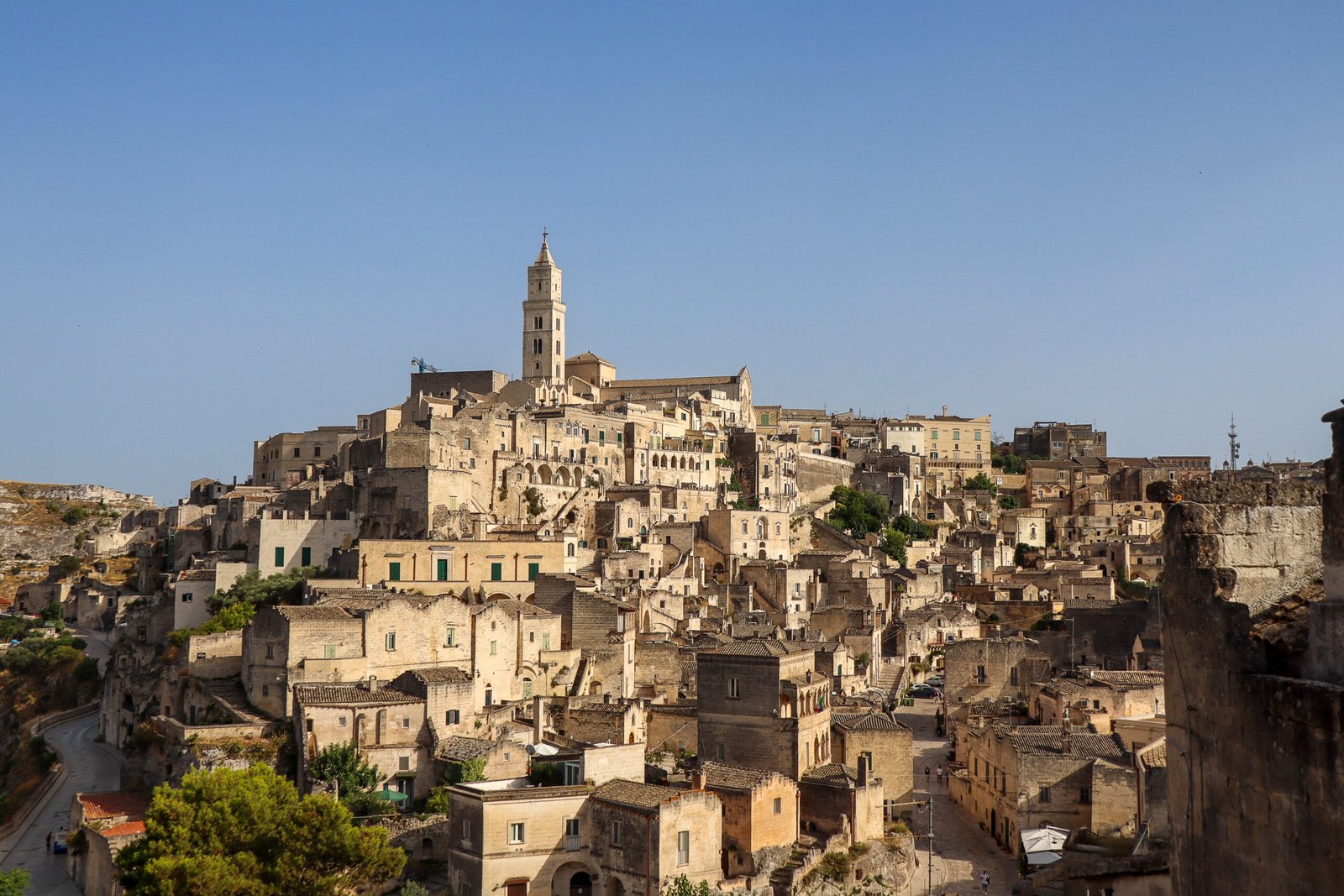
Technically, Matera is in neighbouring Basilicata rather than Puglia, but it was too spectacular to leave off our itinerary.
It was one of the most unique places we visited during the entire month.
Matera’s famous Sassi are ancient cave dwellings carved into the rock, forming a landscape that feels unlike anywhere else. The city has been continuously inhabited for thousands of years and is a UNESCO World Heritage site. The city has also provided the backdrop for numerous films, including recent James Bond movies.
We arrived in the afternoon, but the heat made walking through the steep, hilly streets challenging. Instead, we headed to the tourist centre and booked a scenic tuk-tuk tour. It was one of those spur-of-the-moment decisions that worked perfectly.
We were able to see the major viewpoints without spending hours walking, and our driver took us to some beautiful spots that we wouldn’t necessarily have found ourselves.
We also picked up traditional treats, including Pane di Matera, and stopped for gelato at MAD Matera.
We had planned to stay for dinner at a cave restaurant, but our daughter injured herself stepping wrong in the cave museum, so we cut our visit short.
Even with that, Matera was unforgettable.


Alberobello: Go early
If you’ve seen photographs of Puglia, chances are you’ve seen Alberobello.
This is the famous trulli town, and it is every bit as photogenic as you’d expect. The downside is that everyone else knows it too.
We visited early in the morning, which made a huge difference. There were still plenty of tourists, but it was much more pleasant to wander the streets before the heat and crowds really built up. The scenic area is relatively close together so a couple of hours is more than enough.
We walked around, admired the trulli and, naturally, stopped for gelato. Alberobello is absolutely worth seeing – just don’t expect to have it to yourself.


Lecce: Baroque beauty
Another early-morning visit took us to Lecce, where the ornate Baroque architecture makes the city feel completely different again.
The Basilica di Santa Croce and Piazza del Duomo were among our favourites.
And, because food is always part of our sightseeing, we stopped at Caffè Alvino for a drink and a savoury rustico – a flaky pastry filled with béchamel, mozzarella and tomato.
This is one of the things I loved about Puglia: every town seemed to have something specific we needed to try.


Polignano a Mare and Monopoli
The coastal towns gave us another completely different side of Puglia. Polignano a Mare is spectacular, with its dramatic cliffs, turquoise water and famous beach tucked between the rocks. Go early.
By later in the day, the crowds are significant, particularly around the most photographed areas. We also enjoyed looking for the little poems and verses painted throughout the town’s streets – an unexpected detail that added to the character of the place.
Nearby Monopoli was another pretty spot. We wandered through the old fishing village, explored the port and stopped for gelato.
Try a prawn sandwich – another reminder that travelling through Italy isn’t just about seeing the sights. It’s about eating what the region does well.
On another day, we made time for a swim at Apani Beach, where we finally got into the Adriatic. There are plenty of areas where you can access the beach without paying for an umbrella if you are just looking for a swim.


A quieter side of Puglia
Not every stop needs to be famous.
Francavilla Fontana was much less touristy than some of the other towns we visited. We definitely stood out as tourists as we wandered around, but that’s part of what made it interesting. We enjoyed a cold treat, explored the town and picked up some nuts at the outdoor market.
We also visited Locorotondo, hoping to see what is often described as one of the prettiest streets in Puglia, although we didn’t have enough time to explore the town as fully as we would have liked.
And in Ceglie Messapica, we celebrated a birthday with dinner under the stars at Da Matteo Osteria Lenta.
In Savelletri, some of the group even managed to fit in a morning of golf at San Domenico Golf while the rest of us enjoyed a slower start.
That’s another advantage of having a car and staying for a week: everyone doesn’t have to do everything together.


The Puglia driving lesson: ZTLs
Driving in Puglia was relatively straightforward, but there is one acronym you need to know throughout Italy: ZTL. A Zona a Traffico Limitato is a restricted traffic zone found in the historic centres of many Italian towns. Access is generally limited to residents and authorized vehicles, and entering one can result in a hefty fine.
The good news is that the restrictions are generally well signed. The trick is to recognize the signs and park outside the ZTL. Most towns have reasonably priced car parks on the edge of the historic centre, and from there you’ll walk in.
This means you need to build a little extra time into your plans – and be prepared for some walking. We often created our own mini walking tour for each town, identifying the key sights, food stops and places we wanted to see before setting off.
Why Puglia won me over
Puglia gave us so much variety in one week.
We swam in the Adriatic, wandered through whitewashed hill towns, explored ancient cave dwellings, slept in a trullo, ate incredible pasta and cheese, hunted down local pastries and spent afternoons by the pool.
And compared with some of the other destinations on our itinerary, our money seemed to go a little further.
But I think what really made Puglia my favourite was the pace. We weren’t constantly rushing to the next attraction. We could explore a town in the morning, return home for a swim and a rest, then head out again in the evening.
We had the freedom to change our plans.
We could ask our hosts where they would go.
We could stop for gelato because we felt like it (and we always did).
And every town gave us another reason to get back in the car the next morning.
If I were planning the trip again, I’d still spend at least a week in Puglia. If I had more time, I’d split the stay between two bases and explore even more slowly.
Because that’s the thing about Puglia: seven days gave us a taste, but it left us wanting more.


For more on Italy, enjoy these posts.


You must be logged in to post a comment.